
Implementing Branching Conversation Trees for Chatbots
January 1, 2026
technical overview of implementing branched conversational histories—enabling non-linear dialogue exploration by allowing users to extend or revise prior conversation states.
Introduction
Modern conversational interfaces require flexibility to explore alternative paths within a single discussion. Traditional chat architectures represent interactions as linear sequences, limiting users to a single conversational trajectory. Conversation Branching—the capability to create alternate paths from any message node—enables a dynamic, tree-like structure of dialogues.
Conversation Branching extends classical chat representations by modeling dialogue as a tree of messages rather than a flat chronological list. Each node corresponds to a chat message, and edges represent the parent-child relationship among messages. This paradigm allows users to revisit prior points and create new dialogue paths while maintaining the continuity and integrity of the conversation history.
Consider a user editing a previous response to explore a different question path. Instead of overwriting history, the system spawns a new branch—a distinct subtree extending from the edited node. This structural flexibility improves experimentation, contextual exploration, and information retrieval.
System overview
A conversation is modeled as a rooted tree. Each message may have multiple descendants, allowing the formation of subtrees that represent alternative conversational paths.
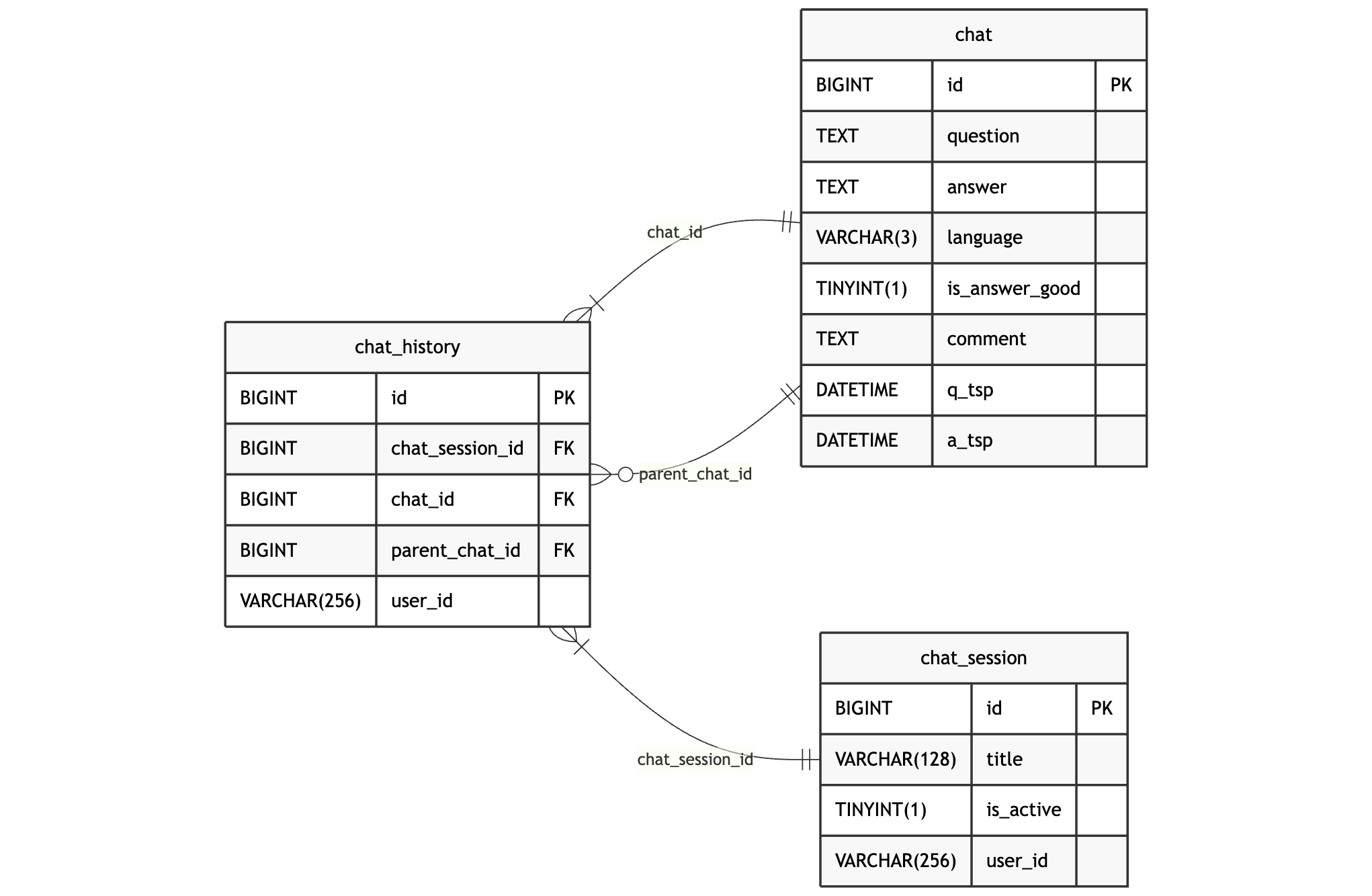
The system defines 3 fundamental entities:
- chat — a single exchange between the user and the assistant.
- chat_history — a parent-child relation between two chats
- chat_session - a chat session belonging to a user
Data model
Structural Visualization
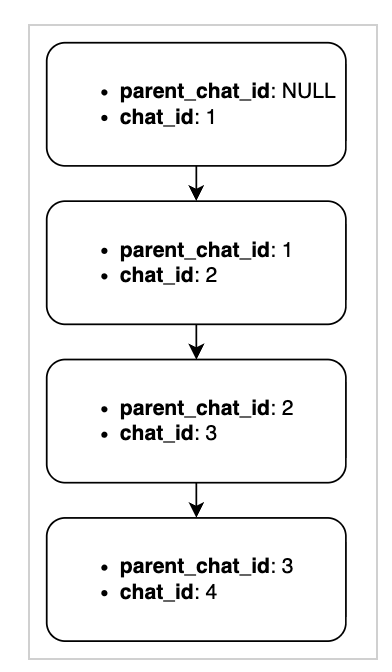
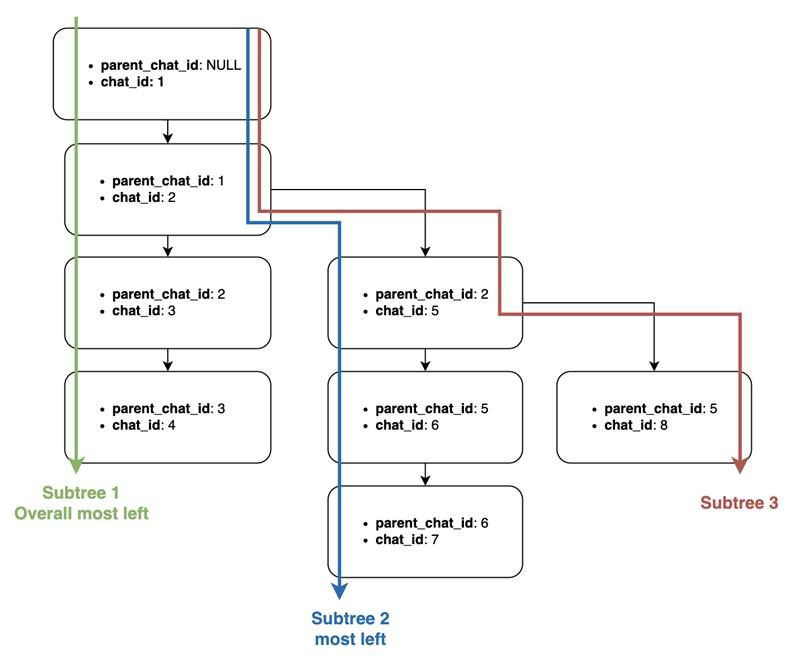
Each branch represents a distinct conversational context. When a user edits or rephrases an earlier message, a new child node is generated beneath the target message, forming a new branch while preserving the original dialogue.
Querying Conversation Trees
Retrieving Children
SELECT * FROM chat_history WHERE parent_chat_id = 2 AND chat_session_id = 1;
Retrieving the Root Message
SELECT * FROM chat_history WHERE parent_chat_id IS NULL AND chat_session_id = 1;Bottom-Up Traversal (Leaf to Root)
Used for reconstructing context to feed into an LLM prompt.
WITH RECURSIVE parent_tree AS (
SELECT *
FROM chat_history
WHERE chat_id = 5
UNION ALL
SELECT t.*
FROM chat_history t
JOIN parent_tree pt ON pt.parent_chat_id= t.chat_id
)
SELECT *
FROM parent_tree p;
Top-Down Traversal (Root to Left-Most Leaf)
Useful for reconstructing the canonical branch for UI rendering.
WITH RECURSIVE parent_tree AS (
SELECT *
FROM chat_history
WHERE chat_id = 2
UNION ALL
SELECT t.*
FROM chat_history t
JOIN parent_tree pt ON pt.chat_id = t.parent_chat_id WHERE t.chat_id = (SELECT MIN(left_most.chat_id) FROM chat_history left_most WHERE left_most.parent_chat_id = pt.chat_id)
)
SELECT *
FROM parent_tree p;
Conclusion
The Conversation Branching feature enables non-linear dialogue exploration and flexible editing within conversational systems. It allows users to initiate new conversational trajectories from any prior message node, thereby maintaining the integrity of the original thread while supporting divergent inquiry paths.